 March 9 to 12, 2017
Grenoble hosted the biennial event for cities in transition, which uses the term "transition" to suggest the need for change, a break with both modes of production and consumption, and even with the global system.
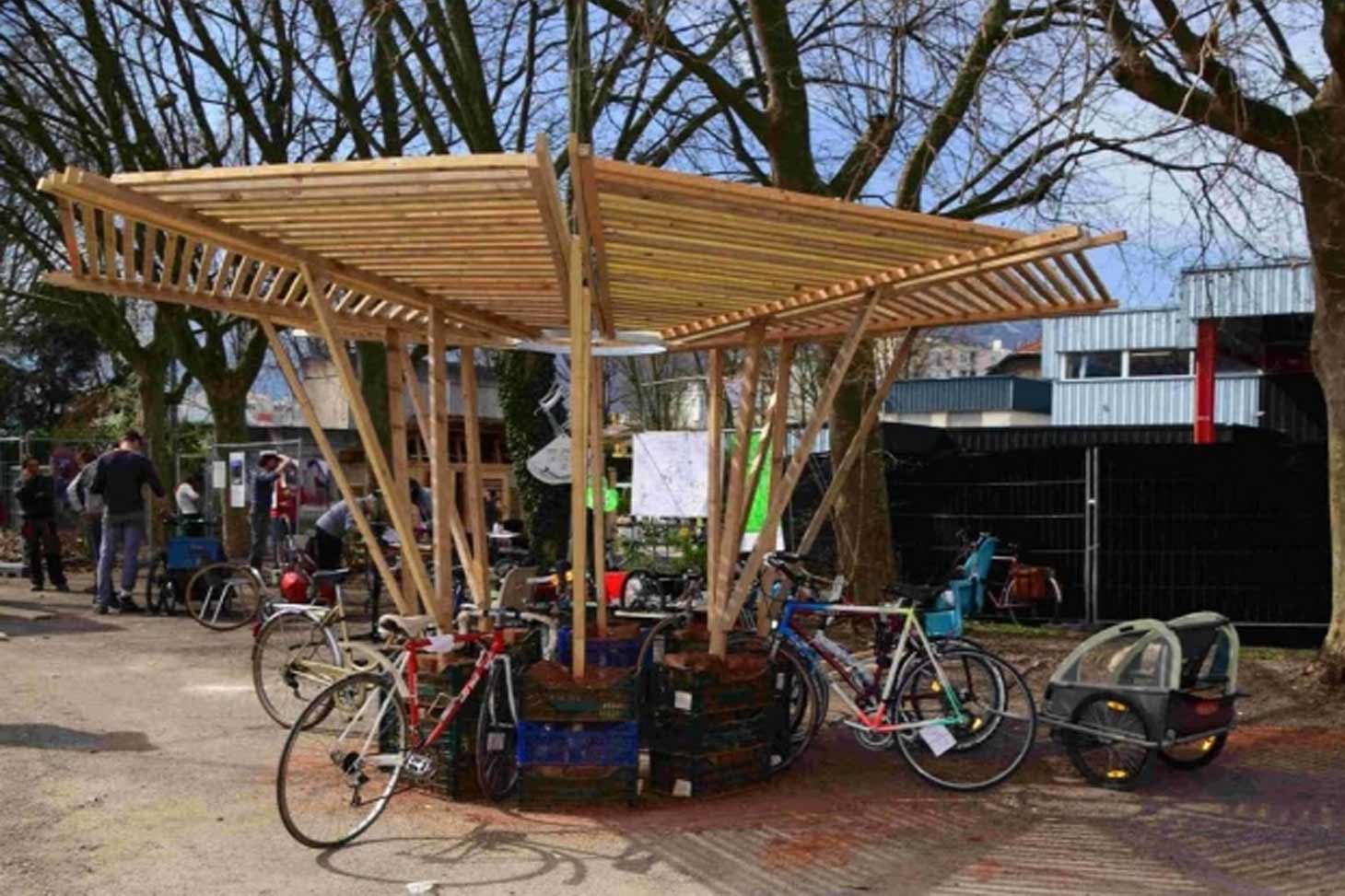
It is a question of changing practices and adapting societies, as well as politics. The aim of the biennial was also to showcase and share new international and local experiences in building sustainable cities of the future. In this context, with the support of the IDEX (Initiatives d'Excellence) of theUniversité Grenoble Alpes community, an exhibition on the creation of bicycle garages, using reused materials, was presented on the Bifurk association site.
This project, initially developed as part of an interdisciplinary teaching activity involving students from ÉNSAG (Grenoble's École Nationale Supérieure d'Architecture) and Civil Engineering Masters students from UFR Phitem (Physics, Engineering, Earth, Environment, Mechanics), involves developing the city of tomorrow, on the one hand, without drawing on natural resources that are only available in limited quantities, and on the other, by conserving the grey energy of materials discarded during deconstruction. This is the reuse of materials. This frugal approach requires construction professionals to rethink their approach. The project is no longer born from an architectural design, which is then realized by ordering materials from suppliers' catalogs, but from available materials, gleaned from the city, which then inspire the architectural form. This perfectly logical process was used in construction right up until the advent of the industrial era. It's the principle of using locally available materials, rooted in a territory and local know-how.
So, unlike contemporary construction, which is overly constrained by technology, the architect redevelops his creative capacity. The engineer, deprived of his standards and adapted calculation codes, rediscovers the ingenuity of his profession and the common sense of the fundamental principles of mechanics. Together, they can take up this new challenge and experiment with innovative solutions for the future. However, this transitional approach requires learning, both in terms of method, but also in terms of setting up interdisciplinary work. It therefore needs to be taught and tested in higher education. In Grenoble, the ZAC Flaubert is an opportunity to develop this transition on a real scale. The developer, SAGES, is well aware of this, and is encouraging higher education establishments to experiment with on-site solutions in anticipation of future challenges!
Work is currently in progress, and the final structure will be installed in May.