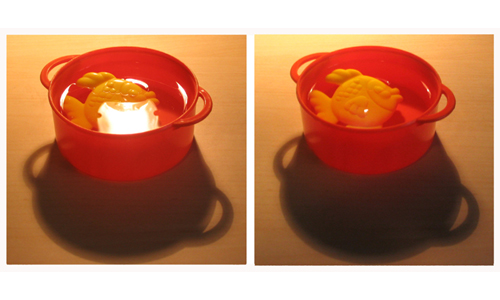
Anti-glare filter. Reflection on a dielectric (in this case, water) produces polarization perpendicular to the plane of incidence (total at Brewster's angle). A polarizing filter can therefore be used as an anti-reflective filter (this is the principle behind glacier or fishing sunglasses). The image on the left was taken without a polarizer, while the image on the right was taken through a vertical polarizer.
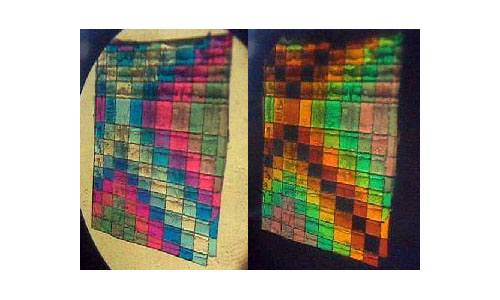
Double refraction of Scotch tape. The object consists of overlapping pieces of Scotch tape. It is illuminated with white light and placed between two polarizers (Polaroid film). Its image reveals colors characteristic of the thickness and orientation of the Scotch tape strips. The colors are different (complementary) depending on whether the two polarizers are parallel (image on a light background, left) or perpendicular (image on a black background, right).
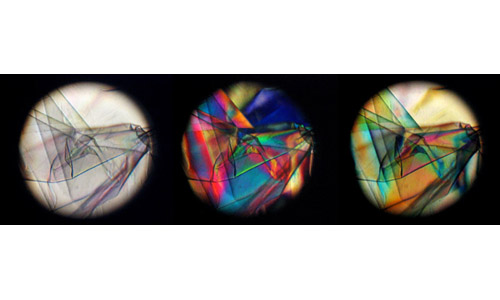
Birefringence of cellophane film (packaging film). The first image is taken with a single polarizer, the next two with two polarizers that are perpendicular or parallel. Download a movie showing the rotation of one of the two polarizers.
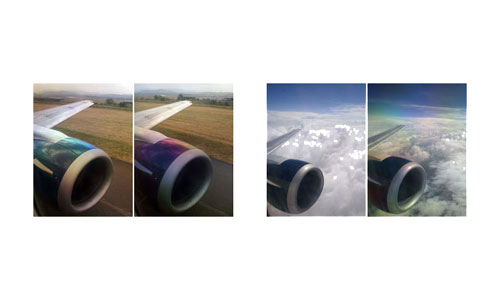
Photos taken from an airplane window: on the left with a polarizing filter against the camera lens, turned in two perpendicular directions. right without and with polarizing filter. Light polarized by reflection on the surface of the reactors or by diffusion on the blue sky passes through the Plexiglas (birefringent) window, then becomes colored by interference when it passes through the camera's polarizing filter.
Published on March 13, 2017 Updated on June 20, 2017
Share linkCopyCopyClose modal windowShare this page URLI recommend this page:Available at this address :The page will then be accessible from your "My favorites" menu.Stop videoPlay videoMute soundPlay soundChat: Got a question?Chatbot Robo FabricaMatomo visitor statisticsX (formerly Twitter)