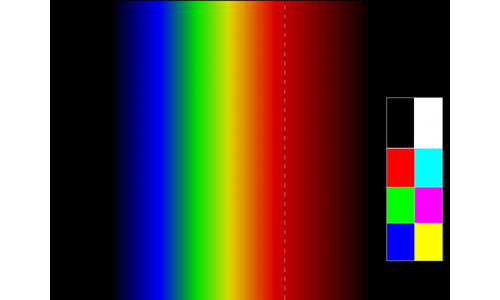
Additive synthesis : The primary colors (red, green, blue), secondary colors (cyan, magenta, yellow), white, and black are represented in this image. Point the optical fiber of a CCD spectrometer at the different colored areas of the computer screen to demonstrate the principle of color creation through additive synthesis of the three primary RGB colors.
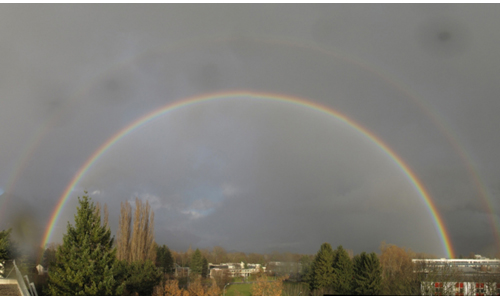
Rainbow (The second arc, outside and inverted, due to double reflection in the water droplets, is slightly visible, as is the dark area between the two arcs and the oscillations under the main arc.)
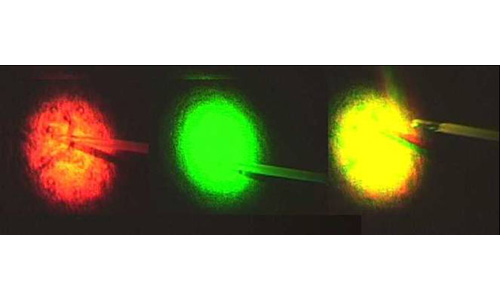
Color addition with 2 lasersRed HeNe (633 nm) + green-doubled YAG (532 nm) = "yellow." Using a fiber optic spectrometer, it can be verified that the yellow color obtained is not monochromatic.
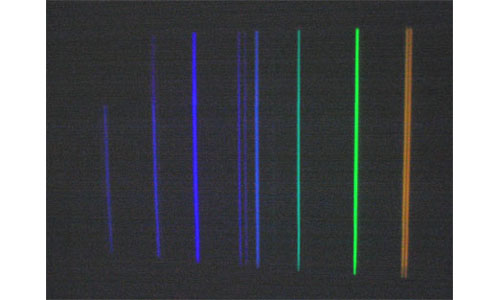
Spectrum of a HgCdZn lampIn particular, the yellow mercury doublet (577 and 579 nm) can be seen on the right, and the mercury UV line (365 nm) on the left, which appears blue due to fluorescence on a sheet of paper containing optical brighteners (this sheet does not occupy the entire height of the screen: so you can see at the top of the image that the UV line is indeed invisible without fluorescence).
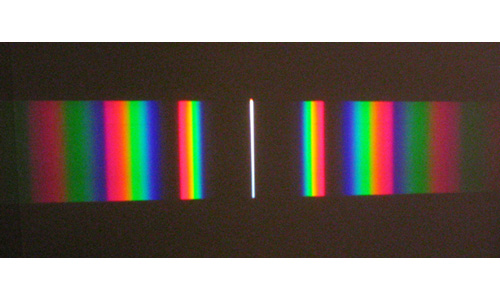
Spectra of an incandescent lamp obtained with a grating - problem of order superposition. In the center, we can see order 0, which is non-dispersive and therefore white, and on either side, orders 1, 2, and 3. The higher the order, the greater the dispersion, but only order 1 is isolated from the others. Orders 2 and 3 overlap, which makes them unusable in spectroscopy if the source emits across the entire visible spectrum (in particular, the superposition of the red of order 2 with the violet of order 3 produces a magenta hue through additive synthesis).
Share linkCopyCopyClose modal windowShare this page URLI recommend this page:Available at this address :The page will then be accessible from your "My favorites" menu.Stop videoPlay videoMute soundPlay soundChat: Got a question?Chatbot Robo FabricaMatomo visitor statisticsX (formerly Twitter)