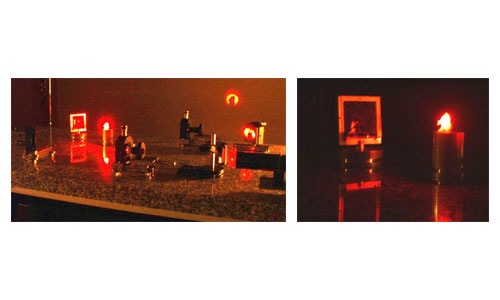
Hologram recording and playback. The set-up (top) is a Mach-Zender interferometer, with a spatial filter in each of the two arms. The source is a 5 mW HeNe laser. The image below shows the figurine and its virtual image observed in the hologram.
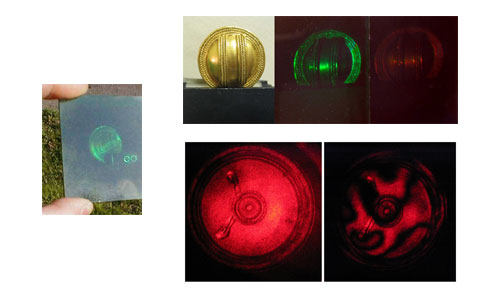
Hologram rendered in white light. On the left, this hologram of a €1 coin was produced by students at the Optics platform. The beam used for recording is a HeNe laser, but the hologram can be rendered in white light (here, it is seen in sunlight). This requires a slightly different set-up from the previous one (a single beam is used, in which the holographic plate is placed immediately followed by the object; interference between the direct beam and that back-scattered by the object is recorded in the volume of the plate, enabling restitution whatever the reading wavelength).
Above, we see the object (a medallion) and 2 holograms rendered in white light, recorded in the same way but with two different chemical processes (fixative or whitener). As the thickness of the emulsion differs according to the type of development, the Bragg condition is different, resulting in a different coloration of the hologram. Below, the object is a loudspeaker. The first hologram was obtained while the loudspeaker was stationary. The second was obtained using a double-exposure method: first, the holographic plate is exposed for half the usual time while the loudspeaker is stationary, then the laser is switched off and the loudspeaker vibrated, and the stationary loudspeaker exposure is completed. Between the two exposures, the surface of the loudspeaker changes very slightly on the scale of the laser wavelength, producing interference bangs.
Share linkCopyCopyClose modal windowShare this page URLI recommend this page:Available at this address :The page will then be accessible from your "My favorites" menu.Stop videoPlay videoMute soundPlay soundChat: Got a question?Chatbot Robo FabricaMatomo visitor statisticsX (formerly Twitter)