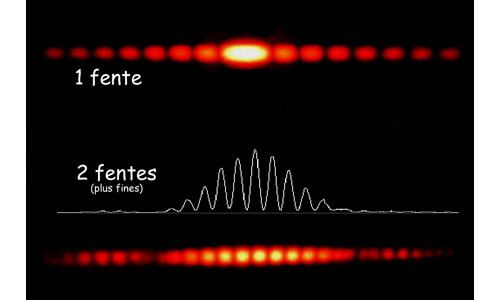
Diffraction of a laser beam by 1 or 2 slits. The intensity profile of the diffraction pattern obtained with 2 slits was measured using a CCD array.
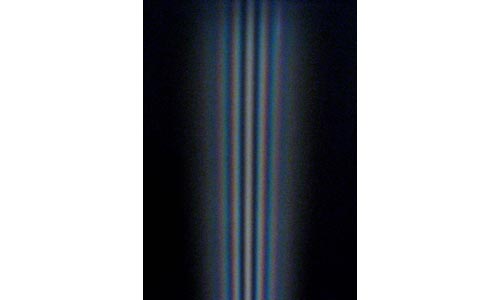
Interference bangs produced by a Young's slit illuminated in white light. The source is an incandescent lamp followed by a condenser and a thin slit parallel to the Young's double slit.
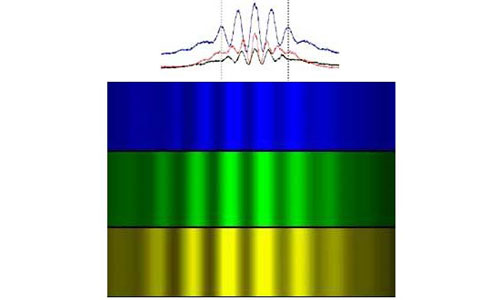
Interference bangs produced by a Young's slit illuminated by a white source followed by various colored filters (red, green, blue). Different filters (blue, green and yellow) were also used at the bottom. This image was produced using the grayscale display of the Caliens software which controls the CCD array.
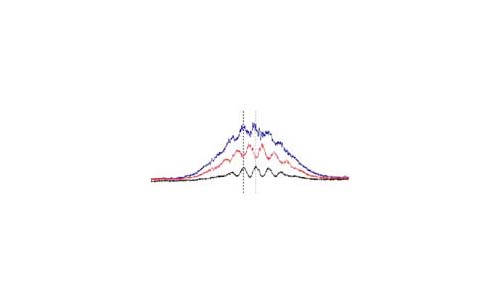
Interference bangs produced by a Young's slit illuminated by a source slit of different sizes. As the source slit is progressively widened, the loss of spatial coherence causes an overall decrease in contrast, as well as periodic contrast inversions (black bangs replace white ones). This figure was recorded using a CCD array. By clicking on it, you can download a pdf file giving more details and enabling you to make measurements.
Interference bangs obtained at the point of intersection of two slightly inclined laser beams, obtained using a laser and a beam splitter.
Mach-Zehnder interferometer. Interference appears only in the area where the two beams are superimposed. The bangs are curved, proving the presence of a non-planar surface at wavelength scale.
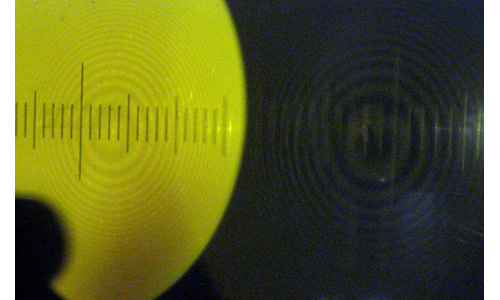
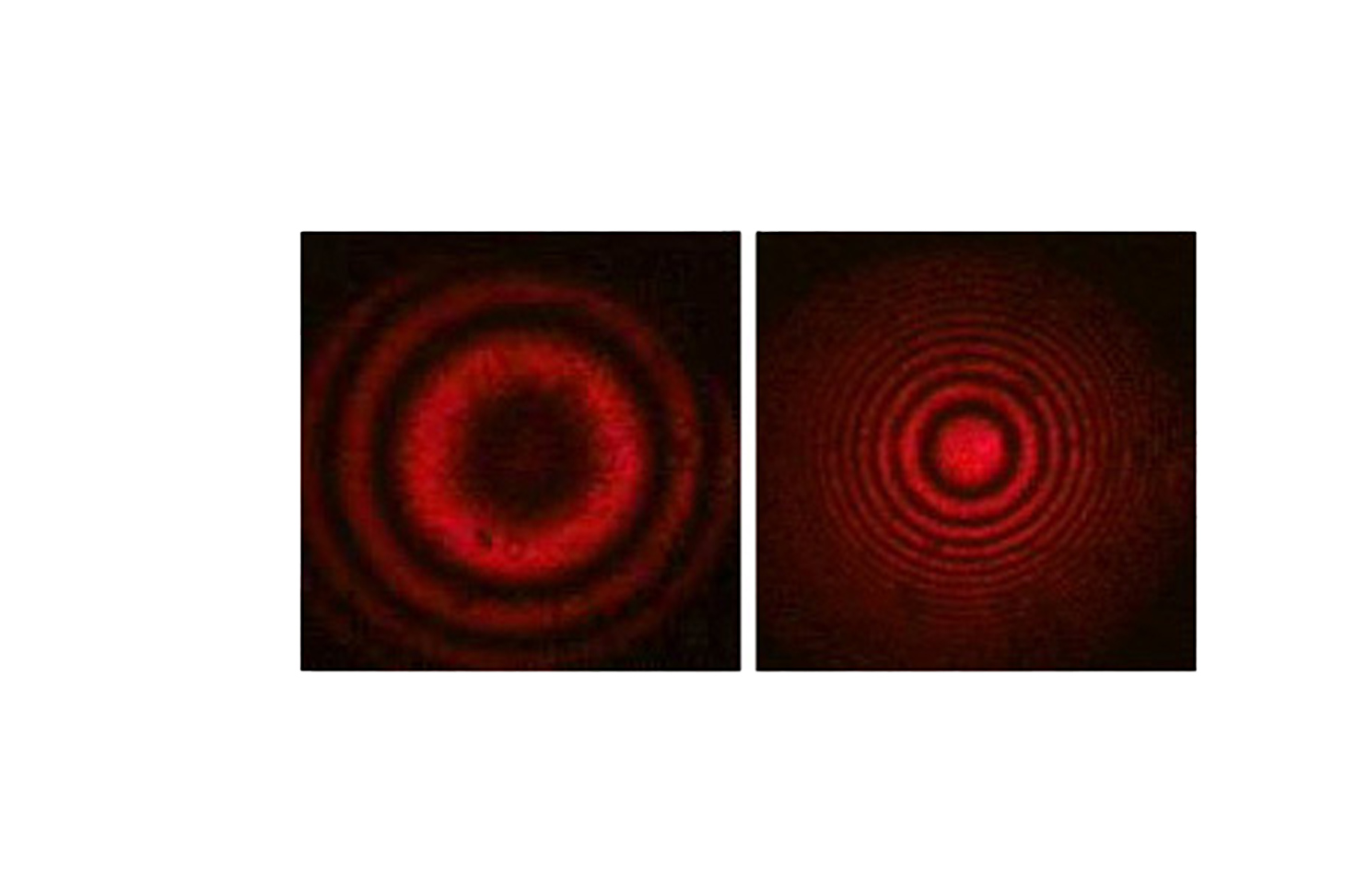
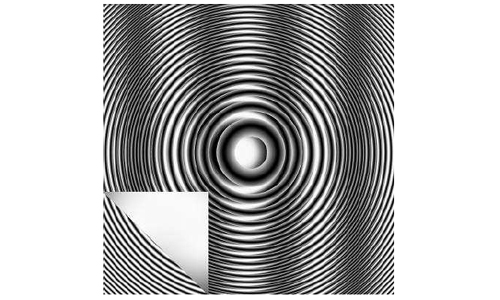
Newton rings illuminated with yellow light, observed in transmission (left) and reflection (right).. In transmission, brightness is better, but interference contrast is weaker. The rings are increasingly squeezed outwards, showing the curvature of the air gap in the device.
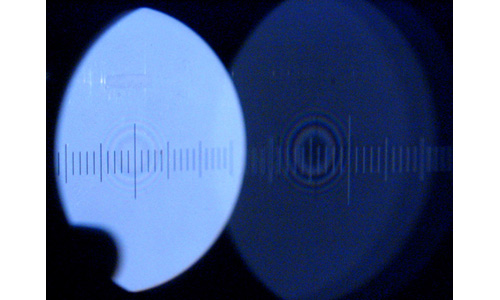
Newton rings illuminated in white light. The rings are only well contrasted at the center (low interference order). Away from the center, they become increasingly iridescent, then disappear (higher-order white) as soon as the air gap thickness exceeds the source's temporal coherence length, in this case a few µm (above, with a colored filter, temporal coherence was much better).
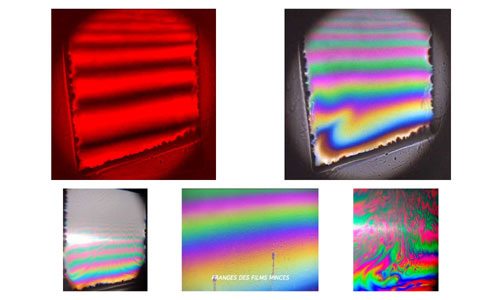
Thin film bangs observed on a soap slide held on a vertical support When illuminated with red light, non-equidistant bangs are observed, showing that the thickness of the blade does not vary linearly with height; when illuminated with white light, Newtonian hues are observed, characteristic of the local thickness of the blade. Bottom left: in the lower part of the blade (where it is thickest), we observe a higher-order white (the image - projected here with a single lens - is inverted). Bottom middle: close-up of the blade at rest; bottom right: disturbance by an airstream.
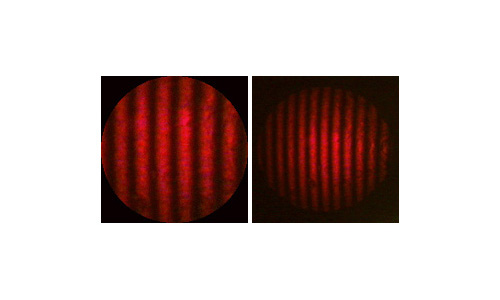
Bangs of equal thickness obtained by illuminating a Michelson interferometer in "air wedge" configuration with a HeNe laser, for two different values of the wedge angle (smaller on the left).
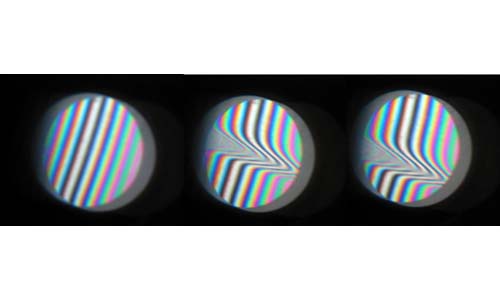
Air wedge bangs localized on the mirrors of a Michelson interferometer illuminated by white light. Disturbance caused by a gas jet (dusting can).
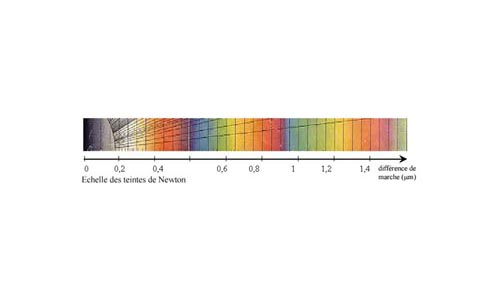
Newton's color scale (M. Levy). Allows you to make the connection between interference color (the object is illuminated in white light) and step difference (double the optical thickness, if the incidence is low).
Moiré figures print on transparency (click on the image to download the complete file) to illustrate different types of interference geometrically (a on a: superposition of 2 monochromatic plane waves; b on b: air wedge or Young's holes; b on d: air gap; a on c: doublet). Download a Fresnel grid or a line network to be printed on transparency. Ref : see article BUP 939, S. Zanier 2011.
Published on March 13, 2017 Updated on June 20, 2017
Share linkCopyCopyClose modal windowShare this page URLI recommend this page:Available at this address :The page will then be accessible from your "My favorites" menu.Stop videoPlay videoMute soundPlay soundChat: Got a question?Chatbot Robo FabricaMatomo visitor statisticsX (formerly Twitter)