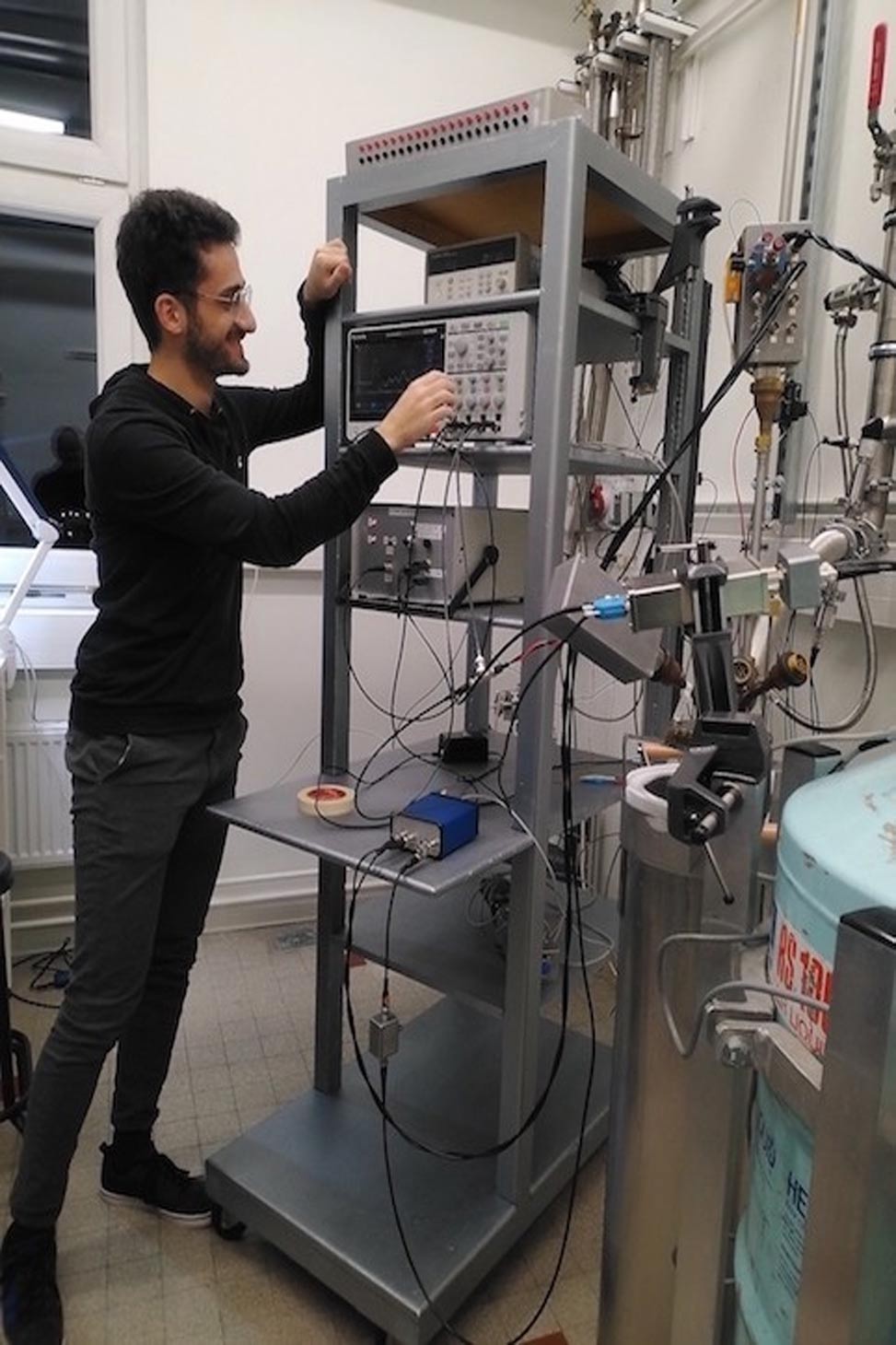
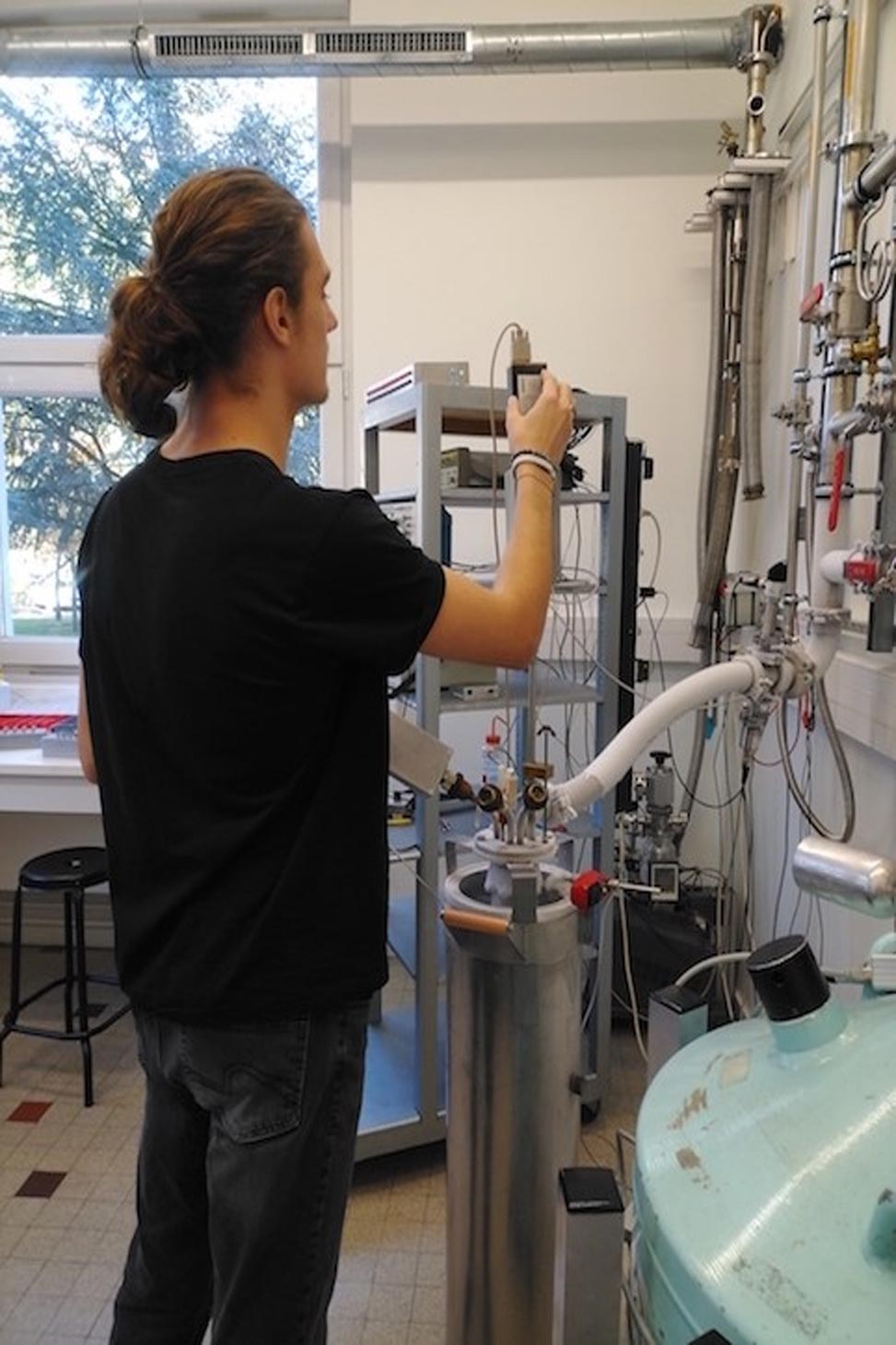
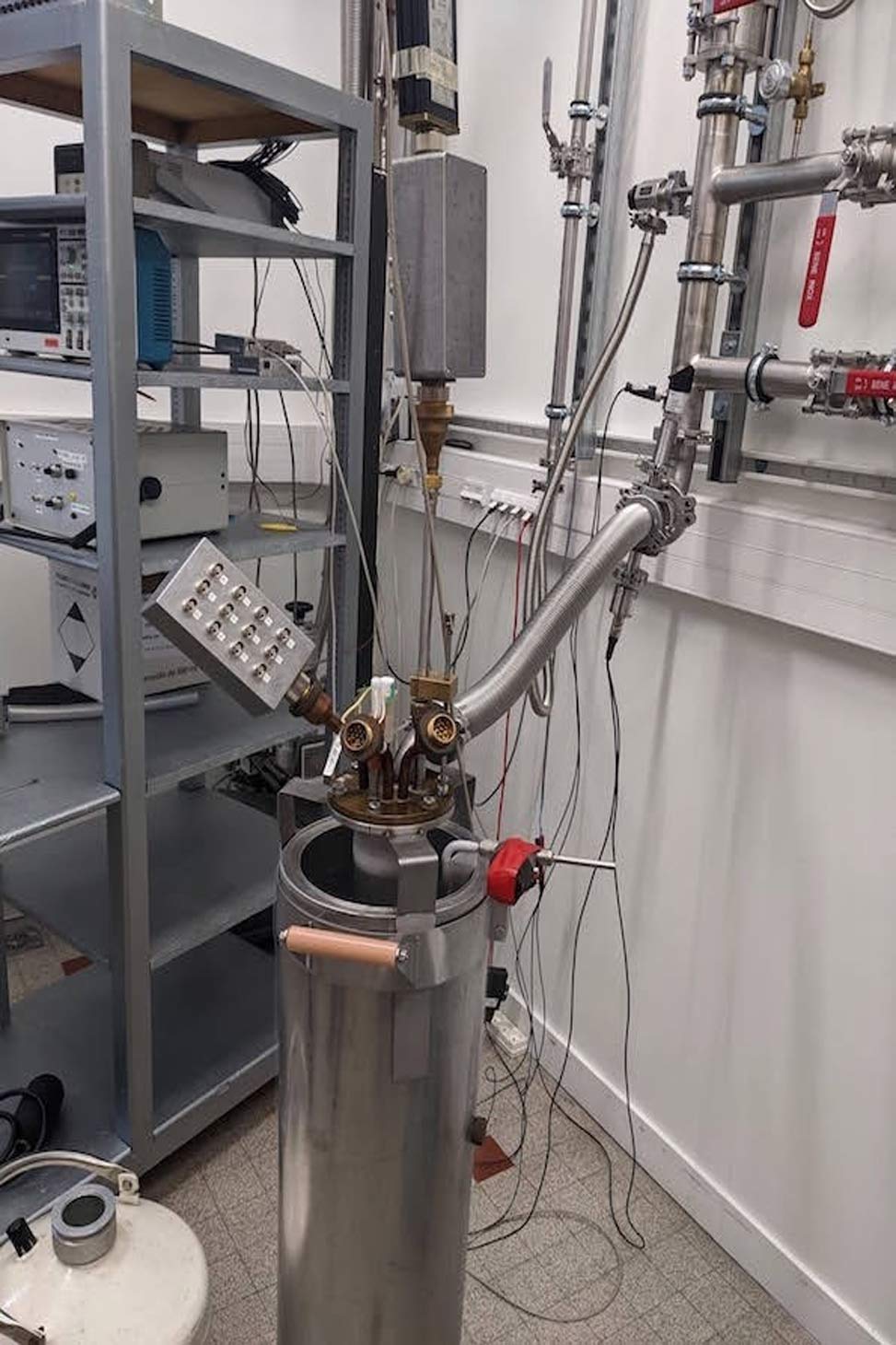
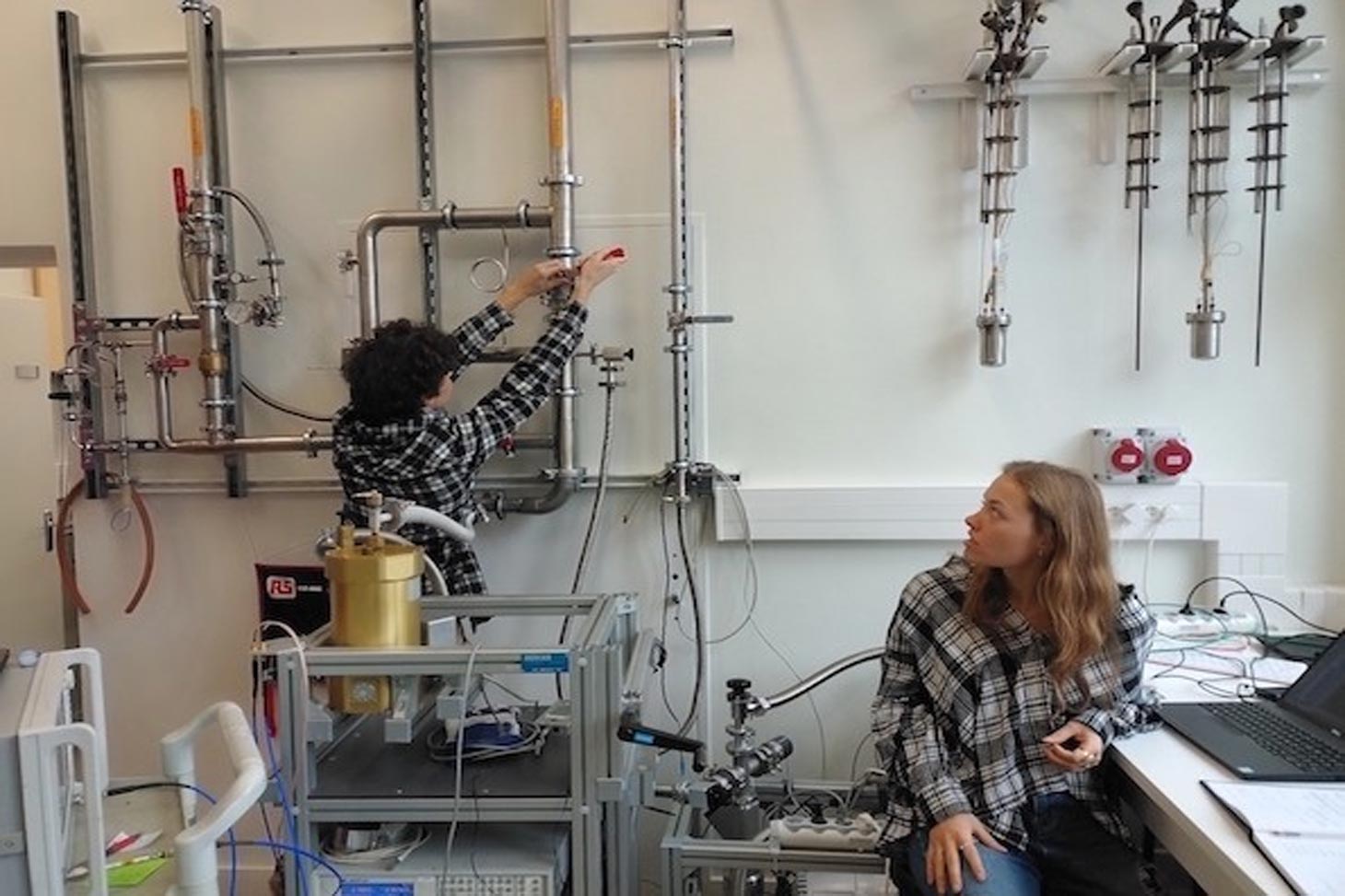
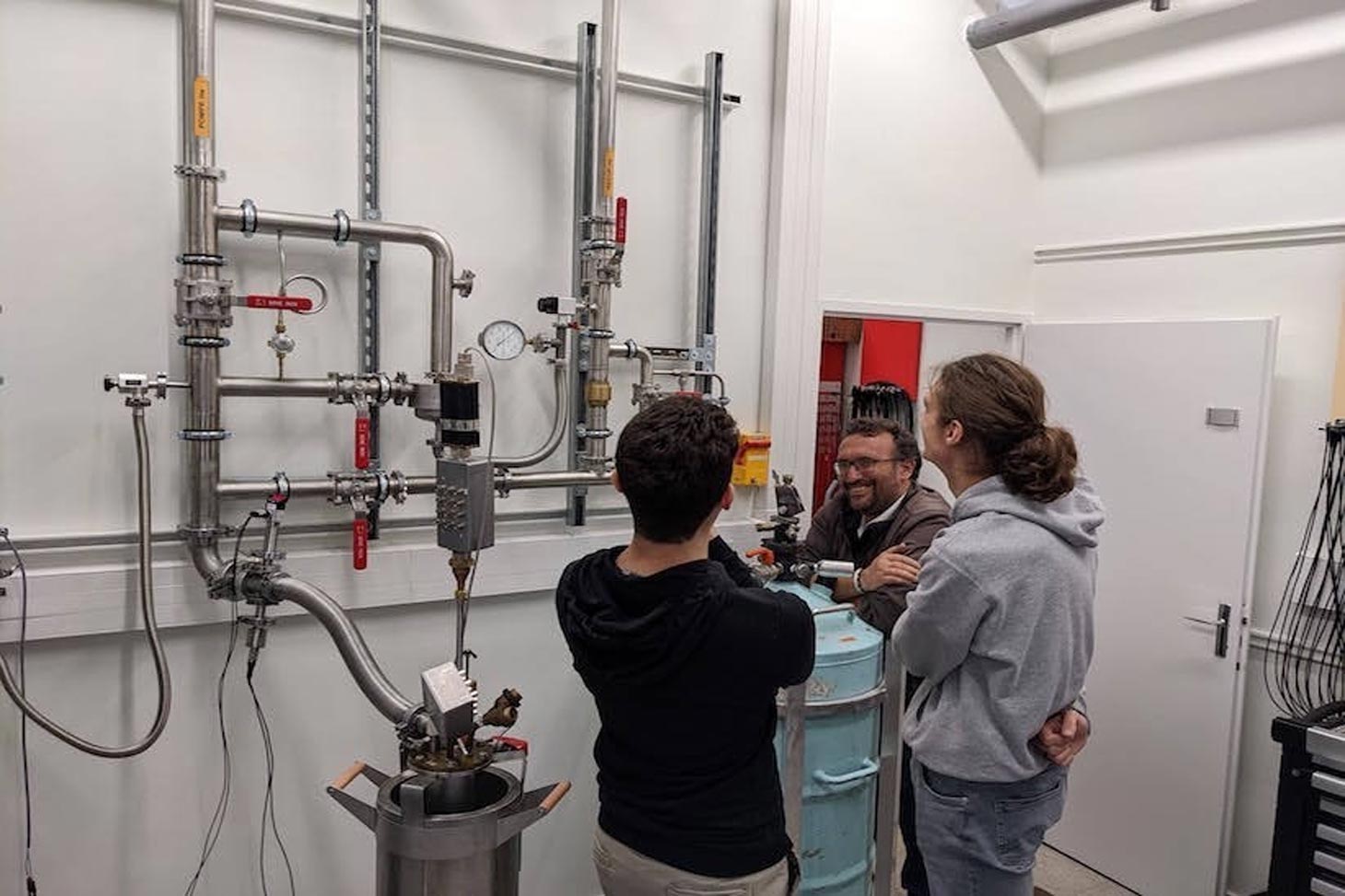
In 2022, a platform dedicated to teaching cryogenics techniques was inaugurated, for Master's and PhD students. This platform offers experimental training using experiments operating at temperatures of around 4 Kelvin, which is very rare in the national university landscape.
While it's relatively simple to work at temperatures up to 77 Kelvin (with industrially available liquid nitrogen), access to liquid helium production, storage, distribution and recovery facilities is much more complex and expensive. This platform takes full advantage of the infrastructures available at the Institut Néel. Given the development of cryogenics in industry and research, the skills acquired by the students are a significant asset for their future professional careers.
The location of this platform within a Physics Laboratory equipped with high-performance Poles and Technical Services, also enables students :
carry out condensed matter physics experiments close to current research themes.
access to state-of-the-art experimental equipment and dedicated instrumentation, benefiting from technological innovations developed in the laboratory.
interact with researchers and immerse themselves in the world of experimental research.
All these points contribute to the maturing of their professional project.
From the start of the 2024 academic year, students who so wish will have access to the platform's measurement instruments prior to their practical work sessions. This will enable them to familiarize themselves with, and improve their skills in, the measurement of weak signals.
This CryoPhysics platform was made possible thanks to a significant logistical and financial effort by the Institut Néel, as well as financial support from the UFR PhITEM and the LANEF alliance. Today, several experiments are on offer.
Pedagogical objectives
The experiments proposed in this CryoPhysics platform are designed to last from 8 to 20 hours of manipulation, spread over several sessions. Students design their experiment, dimension it, assemble it, wire it up, instrument it, then cool it using appropriate cryogenic techniques, before taking measurements and exploiting the physical results.
The pedagogical approach is to give students a sense of responsibility by having them carry out clearly identified tasks, while delegating decision-making in a number of experimental choices. The length of the sessions and the complexity of the experiments allow for a trial-and-error approach.
Proposed hands-on experiments (2024)
Josephson effect:
A Josephson junction of the Supra - Insulator - Supra type is manufactured: the two superconducting parts are made of Niobium (Tc ≈ 9 K) and the insulator is obtained by natural oxidation of the latter. The experimental device is inserted in a tank of liquid Helium (4.2 K) and allows fine-tuning of the contact between the superconducting parts. The current-voltage characteristic of the junction is measured, as is its dependence on a magnetic field and a radio-frequency field (Squid effect, Shapiro steps).
Indium superconductivity
A pure indium sample (wire ≈ 50 cm long and ≈ 0.5 mm in diameter) is prepared and connected. This sample is immersed in a pumped helium bath, allowing the critical temperature of indium to be reached (Tc ≈ 3.4 K). Indium's thermodynamic critical field is then obtained by measuring the wire's critical current, above which superconductivity is destroyed. The field-temperature phase diagram of indium is deduced.
Measuring the specific heat and latent heat of Helium
A cupronickel capillary tube, fitted with several thermometers and a heater, is sized and prepared. This system is placed in a calorimeter and liquid helium is circulated through the capillary under controlled pressure. The resistor heats and eventually vaporizes the Helium. The flow rate and the temperatures measured upstream and downstream are used to determine the specific heat and latent heat of Helium around 4 K.
Measuring the speed of second sound in superfluid helium
We demonstrate the wave mode of heat propagation in the superfluid phase of helium (at T ≤ 2.17 K). To this end, a set-up is constructed in which the distance between a heating element and a sensitive thermometer can be varied in a pumped helium bath. Measurements are taken either in the time domain (pulse technique) or in the frequency domain (resonant cavity technique). In both cases, the propagation speed of the heat wave is deduced as a function of temperature.
Characterization of superconducting detector arrays (Kinetic Inductance Detector)
We are studying the properties of Niobium-based superconducting resonators. These resonators have quality factors of up to 106, thanks to their superconducting state. Detector arrays are mounted on a measuring rod, allowing the temperature to be varied. A vector network analyzer is used to determine the evolution of the resonance frequency as a function of temperature, and to relate it to the superconducting gap and the critical temperature of Niobium.
Measuring the adsorption of a gas on a porous material
We are studying the adsorption of a gas (Argon) on the surface of a porous material (Silver), at cryogenic temperatures. Interactions between adsorbent and adsorbate are electrostatic and therefore weak and reversible (physisorption). First, the sample is manufactured, then the quantity of gas adsorbed and the equilibrium pressure are measured on isotherms. This enables the physical parameters of the substrate to be determined, in particular its specific surface area.
Share linkCopyCopyClose modal windowShare this page URLI recommend this page:Available at this address :The page will then be accessible from your "My favorites" menu.Stop videoPlay videoMute soundPlay soundChat: Got a question?Chatbot Robo FabricaMatomo visitor statisticsX (formerly Twitter)